What was observed
Terra observes the cloud openings
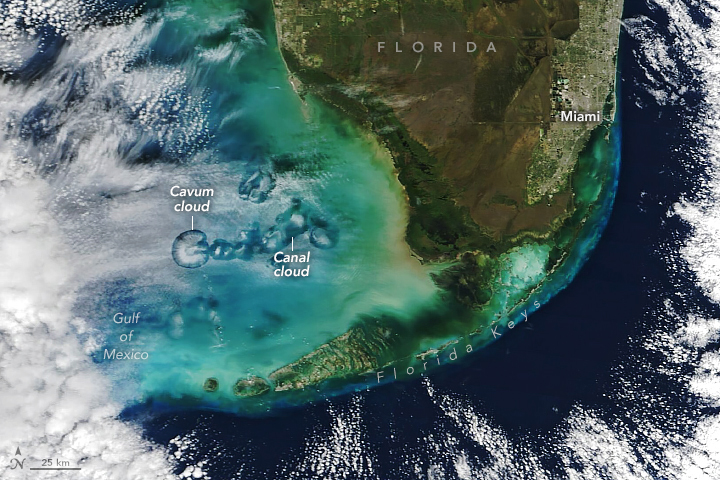
MODIS recorded the scene on this date. NASA identifies cavum and a canal cloud. The source supplies one acquisition date, so this timeline does not invent the times at which individual holes began or widened.
Selected observations & analyses
These entries preserve the source’s reported quantities or analyses. They are not a newly processed observational dataset.
| Evidence | Reported value or finding | Provenance |
|---|---|---|
| Observation date | 30 January 2024 | Terra / MODIS scene identified by NASA Earth Observatory; the article was published later, on 26 February. |
| Visible geometry | Rounded openings and an elongated canal | NASA’s annotated image distinguishes two forms within the cloud field; shapes are visible evidence, not a direct temperature measurement. |
| Instrument view | Natural-color satellite image | A view of cloud and surface appearance; no ground rain gauge or aircraft flight track is supplied for these individual holes. |
The atmospheric mechanism
Supercooled droplets remain liquid below the usual freezing point. Rapid expansion of air around an aircraft can cool a small volume enough to initiate ice formation. Ice particles grow, and precipitation removes cloud material from part of the layer, leaving an opening. Aircraft crossing a cloud layer at different angles can help produce a compact hole or a longer canal. NASA explains the Florida forms using this established process; the source does not identify a particular flight responsible for each opening.
The mechanism has evidence beyond an unusual shape. NCAR’s account of a separate Colorado field study describes aircraft observations, radar, lidar and flight-track comparisons used to investigate aircraft-induced cloud holes. Those measurements support the general explanation, but they are not observations collected in Florida on this date. Keeping that distinction allows a familiar mechanism to explain a new scene without borrowing another event’s measurements.
What the evidence does not establish
This image cannot show whether the falling particles reached the sea, how much water was removed, or the full life of any hole. A dark opening may expose the surface beneath rather than indicate dark cloud. The visible color and hole shape also do not determine an exact cloud temperature. The single dated frame is valuable evidence of occurrence, while its missing time history is a reason to avoid assigning growth rates.
Begin with what is visible, then name the process supported by wider observations. A good cloud explanation can be confident about the mechanism while remaining cautious about the history of one particular cloud.
Sources & provenance
- Making Sense of Holes in the Clouds NASA Earth Observatory · 2024-02-26Article referenced through original paraphrase. The separately credited NASA documentary image is reproduced under NASA Images and Media Usage Guidelines; item-level permission and file identity are recorded in the media rights register.
- The hole story NCAR & UCAR · 2010-06-10Reference only; original paraphrase; no source media reproduced.
Explanations and diagrams are original educational interpretations. Source institutions have not endorsed or reviewed this publication. How we distinguish evidence from models.